
Jurisdictions
Regions
Industry Sectors
28/08/19
Building Resilient Family Enterprises through Risk Management
Increased globalisation and the arrival of new technologies have created countless growth opportunities for businesses and have improved the lives of millions of people around the world. At the same time, this has contributed to increased competition and the potential for disruption, leading to uncertainty and to the perception that we live in a riskier environment.
The World Economic Forum (WEF), for example, recently described the world as being on “the brink of a systems breakdown.” The fact that trust on a global scale is in a state of deep crisis, both in general and in the case of the world´s most relevant institutions—namely governments, businesses, and the media—also contribute to this perception.
The goal of this article is to provide a brief overview of a risk management model and to outline the strategies some family enterprises are implementing to mitigate risk.
Why Should Risk Management Matter?
Risk management in this context means taking a look at the potential risks that could prevent a family enterprise from achieving its goals. In general, one of the goals of most family enterprises is to remain relevant and successful in the long run; i.e. family enterprises want to become sustainable and resilient. In this respect, many academic studies have linked long-term success and resilience to certain values and behaviors that can be summarised as having a culture of adaptability. As Andy Grove noted in his famous book ‘Only the Paranoid Survive’. Businesses periodically face “strategic inflection points” that change the rules of the game. These inflection points, however, also imply new opportunities that could allow the business to emerge stronger than before. It is in this respect that Grove linked long-term success to a healthy degree of paranoia: "Success breeds complacency. Complacency breeds failure. Only the paranoid survive." Hence, a culture of continuous risk management, i.e. a culture of resilience, is essential to achieve long-term success at the family enterprise.
Types and Examples of Risks
In general, risks can be divided into; (a) systemic or macro risks, which are mostly beyond the control of the enterprise family, and (b) risks associated with the family enterprise, which are more predictable and are thus more controllable by the family.
Regarding systemic risks, the WEF publishes an annual list of the leading risks the world is facing according to a panel of experts. The 2018 edition ranked the global risks as follows: (1) extreme weather events, (2) natural disasters, (3) cyberattacks, (4) data fraud or theft, (5) failure of climate-change mitigation and adaptation, (6) large-scale involuntary migration, (7) man-made environmental disasters, (8) terrorist attacks, (9) illicit trade and (10) asset bubbles in a major economy.
With regards to the risks more associated with the family, a 2017 Family Office Exchange Survey revealed that the key risks identified by family enterprises for the future were essentially those related to internal family affairs, followed by security /cyber security issues, and other investment-related issues:

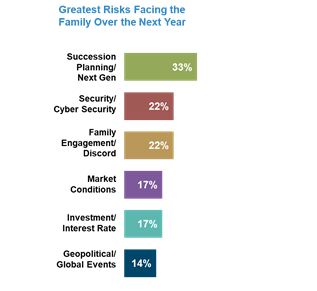
Figure 1: Greatest risks facing the family over the next year. Family Exchange Office Survey 2017
The Risk Management Process
Most family enterprises do not have a holistic risk management process in place. Families also have limited risk management mechanisms for some of their key risks, as the Family Office Exchange survey also shows:
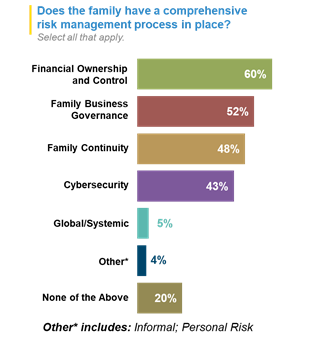
Figure 2: Does the family have a comprehensive risk management process in place? Family Office Exchange Survey 2017
From this we can glean the need to develop a risk management process that includes following the steps below:
- Have a clear vision and goals: This is essential as it clearly defines the failure to achieve the family enterprise´s vision and goals as a risk.
- Set the governance: The Family Enterprise Board should mandate a Risk Committee to oversee the process. Traditionally the responsibility of risk management fell under the Audit & Compliance Committee; however, given the strategic nature of risk management and the fact that it also implies looking at new opportunities, it makes sense to create a specific Risk Committee with a strategic mindset. The Committee´s role will be to lead the process and monitor risks periodically. For this reason, this Committee must possess the talent required for this task.
- Identify the relevant risks: To make the identification of risks easier, these risks could be organised into several layers, depending of the level at which each risk affects the family enterprise. Under such a model, for example, we could talk about risks at the systemic/macro level, at the enterprise level, at the family level, at the business level, and at the financial level.
- Prioritise the risks: All risks identified as potentially affecting the goals of the family enterprise should be ranked according to their potential impact and their probability of occurrence. The Committee should avoid any personal biases, something that may be achieved by setting up a group that is heterogeneous in nature.
- Define the mitigation strategies: Members of the Risk Committee should agree on and implement a mitigation plan with the management or members of the areas affected by each risk to minimise the risk and help the family enterprise adapt to the new situation stemming from the risk.
- Monitor and report: The Risk Committee should monitor both risks and the opportunities associated to each risk and inform the Family Enterprise Board periodically, so that the process becomes part of the culture, potentially becoming a competitive advantage.
Mitigation Strategies
There are several mitigation strategies that can be implemented to reduce the overall impact of risks in general:
- Family enterprise mindset: Reduce the occurrence of a risk by being well organised as a family enterprise, that is, aligned towards a commonly agreed vision and having clear strategies, goals, and governance systems, including clear roles and the right communication protocols.
- Increased knowledge: Warren Buffet remarked that risk arises “from not knowing what you´re doing.”[1] In that respect, families should be much more aware of their competitive environment and their internal operations, especially in the light of the strong liability risks implied by the current legal and tax systems. One potential way of achieving this is through wider and deeper networks at every level including families, advisors, business partners, and others.
- Scenario analysis: Conduct periodic scenario planning and revisit on an ongoing basis to help prepare the family enterprise for negative scenarios.
- Redundancy plans: Have several backup alternatives and diversify business activity in terms of business sector and geography.
- Modularity: Use legal entities or structures to shield the whole family enterprise from a localised risk or problem, and potentially decentralise part of the governance as well.
In addition to these general strategies, there are other tailored strategies that can be taken depending on each specific risk. Typically, high impact risks can be either hedged (the higher probability risks) or insured (the lower probability risks such as systemic risks, however acknowledging that only a few are insurable). Risks with low potential impact but high probability should be tackled by confining the risk as much as possible and defining a plan when the risk event takes place. Finally, risks with low potential impact and low probability could be simply ‘accepted’.
Examples of some of these specific mitigation strategies being employed by enterprise families globally include the following:
|
Risk |
Level |
Strategy |
|
Lack of a common vision |
Family Enterprise |
Agree on a common vision and goals, regularly bringing in advisors to lead the process. |
|
Capital misallocation |
Family Enterprise |
Goal based asset allocation to link goals to financial investments. |
|
Family enterprise continuity |
Family Enterprise |
Having a succession plan in place; implementing the succession plan early on; clear continuity plans. |
|
Family enterprise liability/ reputation issues |
Family Enterprise |
Increased focus on tax and legal compliance; simpler legal structures; on-shoring or mid-shoring, versus offshoring; more professional boards. |
|
Family not prepared or engaged |
Family |
Engagement and education plans for the next generation, often with the help of advisors. |
|
Family alignment |
Family |
Internal liquidity fund to allow an exit for those family members who are not aligned. |
|
Personal liability |
Family |
Comprehensive insurance programs. |
|
Spending level (vs return) |
Family / Family Office |
Cap spending to a given % of assets; match spending to annual returns; manage inflation risk. |
|
Investment Concentration |
Family Office |
Diversify the investments; collar strategies. |
|
Leverage |
Family Office |
Reduce the level of debt; don´t leverage a concentrated position; hedge interest rate variations. |
|
Cyber attacks |
Family Office / Family Business |
Cyber risk management culture; technology solutions; back-up plans. |
Figure 3: Mitigation strategies being employed by enterprise families globally.
The goal of the mitigation strategies is to reduce the potential impact and probability of occurrence of the priority risks, but they will not be able to eliminate risks completely. In addition, a sound risk management process should not prevent the family enterprise from taking some risks, as risk-taking is part of everyday business life and, as mentioned, each risk entails a new opportunity for the family enterprise.
In summary, family enterprises need to implement risk management mechanisms to continually adapt to disruption in order to become resilient over the long run.
[1] Source: “State of the Family Office - 2017 FOX Family Office Study Report of Findings” (June 2017, Chicago, USA). www.familyoffice.com.
[1] World Economic Forum, The Global Risks Report 2018, P. 5, http://www3.weforum.org/docs/WEF_GRR18_Report.pdf (accessed 29 August 2018)
[1] Edelman, 2018 Edelman Trust Barometer, https://cms.edelman.com/sites/default/files/2018-01/2018%20Edelman%20Trust%20Barometer%20Global%20Report.pdf (accessed 29 August 2018)
[1] “Resilience of 100-Year Family Enterprises: How Opportunistic Innovation, Business Discipline, and a Culture of Stewardship Guide the Journey Across Generations” by Denis Jaffe. The “World Economic Forum Global Risk Report 2018” also describes Enterprise Resilience as “the capacity of a company or other organization to adapt and prosper in the face of high impact, low-probability risks”. Source: http://www3.weforum.org/docs/WEF_GRR18_Report.pdf
[1] Grove, A. S. (1996). Only the paranoid survive: How to exploit the crisis points that challenge every company and career. New York: Currency Doubleday.
[1] World Economic Forum, The Global Risks Report 2018, http://www3.weforum.org/docs/WEF_GRR18_Report.pdf (accessed 29 August 2018)
[1] Source: “State of the Family Office - 2017 FOX Family Office Study Report of Findings” (June 2017, Chicago, USA). www.familyoffice.com.
[1] “The Warren Buffett Way: Investment Strategies of the World’s Greatest Investor” by Robert G. Hagstrom Jr., Chapter 4: Buying a Business, Quote Page 94 and 95, John Wiley & Sons, New York, 1994.

Miguel López de Silanes
Miguel López de Silanes is the Managing Director and Market Leader for Europe & Latin America at the Family Office Exchange. He has previously worked at UBS Wealth Management, including New York, Chile and other Latin American locations.