
Jurisdictions
Regions
Industry Sectors
18/04/24
From Features
Transparency vs Privacy

Delve into the intricate balance between transparency and privacy in the evolving landscape of international finance with our feature. We explore the pitfalls of imposing intrusive surveillance on cryptocurrencies, the shortcomings of anti-money laundering laws, and the UK's experience with beneficial ownership registers.
Ownership vs Control: FATF Targets Soft Power
Ownership Vs Control: FATF Targets Soft Power

Advocate Paul Beckett
Visiting Research Fellow, School of Law Oxford Brookes University; Senior Counsel, MannBenham Advocates Limited Douglas, Isle of Man
The Financial Action Task Force (FATF) is an independent inter-governmental body established in 1989, that develops and promotes policies to protect the global financial system against money laundering, terrorist financing, and the financing of proliferation of weapons of mass destruction. [1] The huge significance of the FATF in the context of ownership and transparency is that when reference is made in transparency initiatives to “accepted international beneficial ownership standards” (or words to that effect), it is to FATF guidance. [2]
Some well-meaning initiatives have unintended consequences. This was the case when in 2012, opening the debate on the need for registration of beneficial owners, the FATF offered a helpful suggestion: “A controlling ownership interest depends on the ownership structure of the company. It may be based on a threshold, eg any person owning more than a certain percentage of the company (eg 25 per cent)”.[3]
That “eg” provided the basis for the evolution of a global industry in beneficial ownership avoidance. It is just the work of a moment for an offshore lawyer or wealth manager to make sure that no-one owns more than 24.99 per cent of any structure, thereby eliminating registration requirements altogether. That same footnote is still to be found in the November 2023 updated FATF Recommendations.
It is perhaps too late now to turn the tide, because so many jurisdictions have already adopted the 25 per cent threshold, but in March 2023, the FATF offered an alternative strategy: Not owner…
Crypto Regulation
US Lawmakers Try Familiar Tactics To Impose Sweeping Crypto Surveillance Regime
Major developments in recent months, such as the approval of spot Bitcoin ETFs in the United States,…

AML Regulation
Anti-Money Laundering Laws Don’t Work

L. Burke Files DDP CACM
President, Financial Examinations & Evaluations, Inc
The first Anti-Money Laundering law was the United States Bank Secrecy Act. It was passed in 1970, the Nixon Administration’s knee-jerk reaction to the boatloads of cash flowing into US banks. There were a few additions in 1986 and 1988, reacting to how the criminals had learned to evade the BSA provisions, but nothing substantive.
Substitutive changes in AML and global financial compliance came from the OECD (Organisation for Economic Co-operation and Development) in 1989, which formed a sub-entity called the FATF (Financial Action Task Force). The initial purpose of the FATF was to reduce harmful tax competition and the possibilities of tax avoidance.
It was not until the terrorist attacks on the United States on September 11, 2001, that the concept of crime prevention occurred to the FATF – but it was still about harmful tax competition.
From the OECD: “Countries concerned about the flight of capital and savings from their jurisdictions to low- or no-tax jurisdictions engage in the cycle of tax competition to attract investment. This spiral involves enormous amounts of lost revenue for governments, as well as facilitating the laundering of proceeds from criminal activities. The phenomenon has reached such proportions as to be considered harmful and become a priority on the OECD Fiscal Committee's agenda.”[i]…


Remaining Private: The Double-edged Sword Of PARBOs
Remaining Private: The Double-edged Sword Of PARBOs

Paul Marshall
Pragmatix Advisory

Rebecca Munro
Island economies consultant, Pragmatix Advisory
“The remedy is worse than the disease.” When Francis Bacon penned these words over five hundred years ago, he could well have been writing about the reaction of international finance centres to the contentious attempted introduction of Public Registers of Beneficial Ownership, or PARBOs, by the European Union.
The widescale introduction of PARBOs was intended to extend access to existing private registers held by official regulators and registrars (and already available to international tax authorities and law enforcement agencies) to allow anyone to find out who is the ultimate owner or beneficiary of an asset.

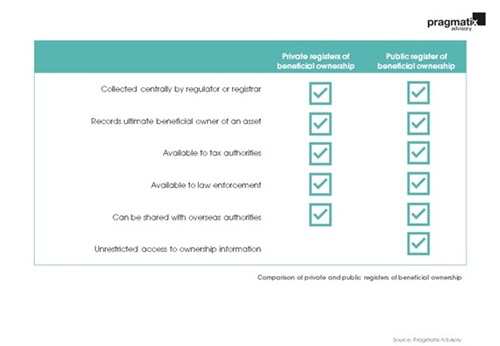
So, if there are already easily accessible private registers that tax authorities and law enforcement agencies can use to prevent money laundering, tax evasion, and criminal financing activities, what is the disease that the PARBO remedy was designed to cure? Well, quite simply, there isn’t one, other than an overwhelming political desire to force transparency, and in doing so, create a sure vote-winner by shining a light on the (supposedly) dark corners in which hide white-collar enemies of the law-abiding, tax-paying working class.
The trouble for the United Kingdom, European Union and others is that public registers are fundamentally at odds with the right to privacy, somethin…